

Table of Contents
Planning always sounds good… until real life starts.
You make a plan on Monday.
By Wednesday, it’s already broken.
I have tried:
- detailed planners
- digital apps
- long to-do lists
None of them stuck.
Not because they were bad…
But, because they were too heavy for everyday life.
So I simplified everything.
This is the weekly planning system I actually use now and continue to use.
Why Most Planning Systems Fail
Most systems fail for one simple reason:
👉 They expect too much discipline.
They assume:
- you will sit every day and review
- you will track everything
- you will stay motivated
That is not real life.
A system should:
- reduce thinking
- reduce effort
- work, even on low-energy days
My Weekly Planning System (Simple Version)
I follow just 3 steps.
Step 1: Weekly Reset (Sunday or Monday)
I take 10–15 minutes and ask:
- What absolutely needs to get done this week?
- What can wait?
- What is already fixed (meetings, commitments)?
Then I write down only 5–7 key tasks for the week.
Not 20.
Not “everything in my head.”
👉 Just a few things that actually matter to stay consistent.
Step 2: Daily Focus (Max 3 tasks)
Every morning, I pick:
👉 3 tasks for the day
That is it.
If I finish them → good day
If not → they move forward
No guilt. No overload.
Step 3: Visible Tracking
I don’t use complicated tools.
I just keep everything:
- visible
- simple
- in one place
So I don’t have to “remember” what I planned and it helps me keep my weekly planning system stable.
What I Use (Keep it simple)
This is important.
I don’t use fancy apps.
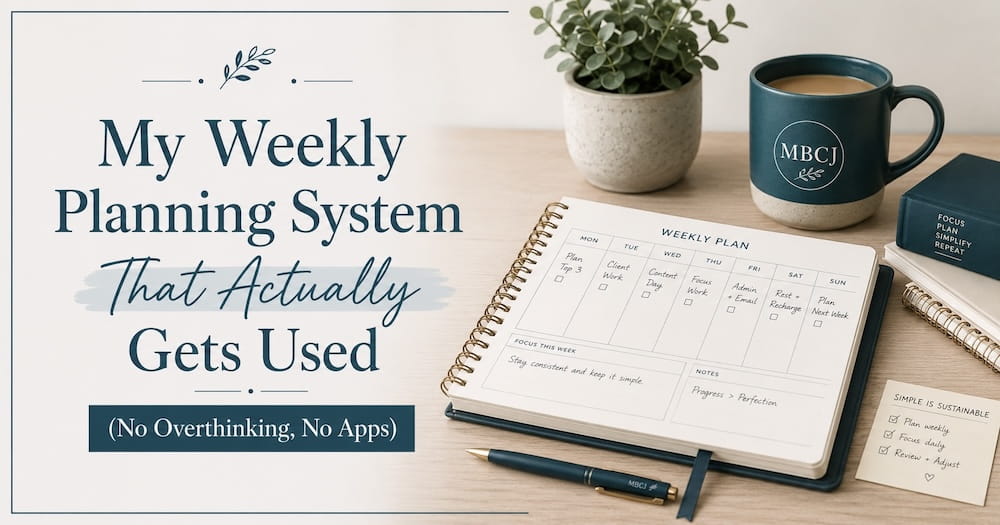
👉 I use a simple notebook/ planner.
Because:
- no distractions
- easy to open
- easy to stick with
You can use anything similar.
I use a simple notebook for this. Nothing fancy… just something I will actually open every day. That is what makes the system work.
If you are looking for something similar, this is the kind of notebook I use:
👉 A6-Notebook
What Changed After This
This system worked because:
- I stopped over-planning
- I reduced daily decisions
- I made it easy to follow
Now:
- I don’t feel behind all the time
- I know what matters each day
- planning takes minutes, not hours
What You Actually Need to Get Started
You don’t need a new system.
You just need:
- one simple notebook
- one pen
- a fixed weekly reset time
That is it.
If you want to see the exact tools I use, you can find them here:
👉 Productivity Tools
Final Thought
Planning should not feel like work.
If your system needs constant effort to maintain…
👉 it is not a system, it is a burden.
Start small. Keep it simple.
That is what actually works.
Once you have your plan, the next challenge is staying consistent. Here is how I stay consistent.
If this system helped, you can save it for later or come back to it anytime.
* This post may contain affiliate links. If you buy through them, I may earn a small commission at no extra cost to you.