
Table of Contents
There are weeks when even simple tasks feel heavier than usual.
You are tired before the day properly starts.
Your brain feels crowded.
Small decisions feel strangely exhausting.
And every productivity system online suddenly seems designed for people with unlimited energy and perfect lives.
I used to think this meant I was becoming lazy or undisciplined. But now I think differently.
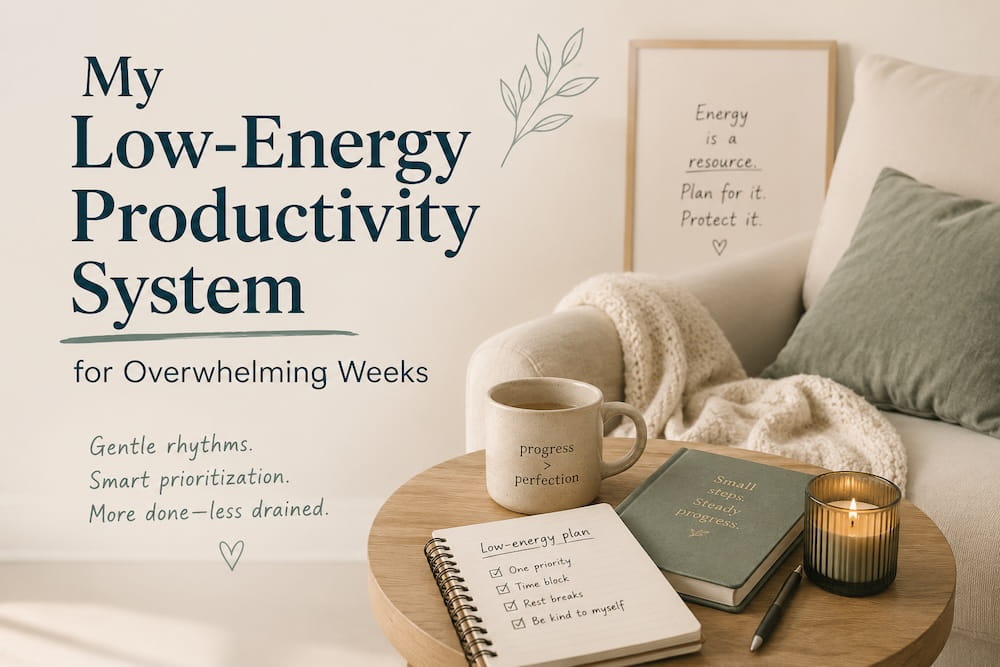
Some weeks simply require a different kind of system. A low-energy productivity system doesn’t try to maximize output. It tries to reduce friction so life can keep moving without everything feeling overwhelming.
Some weeks simply require a different kind of system.
Not a more intense one.
A gentler one.
Because during overwhelming periods, the goal often isn’t peak productivity.
It is maintaining enough stability that life doesn’t completely unravel.
Why High-Energy Productivity Systems Often Collapse
A lot of productivity advice quietly assumes:
- high motivation
- strong focus
- emotional energy
- mental clarity
- ideal conditions
But real life doesn’t work like that consistently. Some weeks include:
- stress
- bad sleep
- emotional overload
- family responsibilities
- burnout
- decision fatigue
- mental clutter
And during those weeks, highly optimized systems usually fail first.
Why?
Because complicated systems require energy to maintain.
That is why I stopped trying to “perform normally” during overwhelming periods.
Instead, I built a low-energy productivity system designed specifically for harder weeks.
What Low-Energy Productivity Actually Means
For me, low-energy productivity is not about doing everything.
It is about:
- reducing friction
- protecting mental bandwidth
- maintaining basic momentum
- avoiding unnecessary collapse
Some weeks are growth weeks.
Some weeks are maintenance weeks.
Both matter.
That mindset shift alone reduced a surprising amount of guilt.
My Rule: Keep Life Moving, Not Perfect
During overwhelming weeks, I simplify aggressively.
Not forever.
Just temporarily.
I reduce:
- unnecessary decisions
- overplanning
- unrealistic goals
- mental load
The goal becomes:
keep life moving gently forward.
That is enough.
What I Actually Prioritize
1. One Important Thing Per Day
…Not ten.
Just one meaningful thing.
Sometimes that is:
- finishing one work task
- replying to something important
- planning the next day
- resetting my environment
- taking care of admin tasks
Completing one important thing creates psychological stability.
And honestly, stability matters more than intensity during difficult weeks.
2. Tiny Visible Wins
Overwhelming weeks make everything feel unfinished.
So I intentionally create small visible completions:
- clearing one surface
- finishing one email
- preparing one meal
- organizing one category
- writing one page
Tiny wins reduce emotional paralysis.
Momentum matters more than perfection.
3. I Stop Trying to Optimize Everything
This one took time to learn.
When energy is low, trying to perfectly optimize routines usually creates more pressure.
Instead, I ask:
“What is the easiest version of this that still helps?”
That question changes everything.
Sometimes the low-energy version is enough.
The Systems That Help Me Most
A few simple systems help repeatedly during overwhelming weeks:
- one notebook for everything
- simple weekly planning
- brain dumps before sleeping
- a small Sunday reset
- repeating meals and routines temporarily
- reducing open loops
None of these are impressive.
and that is exactly why they work.
Simple systems survive hard weeks better.
I have Stopped Treating Rest Like Failure
This may be the biggest mindset shift of all.
I used to think slowing down meant falling behind.
Now I think:
- Exhaustion ignored becomes burnout later
- Overloaded Systems eventually collapse
- Sustainable Systems include recovery
Sometimes the smartest productivity decision is reducing pressure before your brain forces you to stop entirely.
(If mental clutter has been building up quietly, this article may also help.)
That is not laziness.
That is maintenance.
Final Thought
I no longer measure productivity only by output.
Sometimes productivity simply means:
- keeping promises to yourself
- reducing chaos
- protecting your mental energy
- making the next week slightly easier
And honestly?
During overwhelming seasons, that is already meaningful progress.
Related Posts
- Mental Clutter: Why Your Brain Feels Overwhelmed All the Time
- How I Stay Consistent Without Motivation
- Tiny Systems That Quietly Reduced My Daily Stress
- The 15-Minute Sunday Reset That Stops My Week From Falling Apart
* This post may contain affiliate links. If you buy through them, I may earn a small commission at no extra cost to you.
[…] My Low-Energy Productivity System for Overwhelming Weeks […]