

Table of Contents
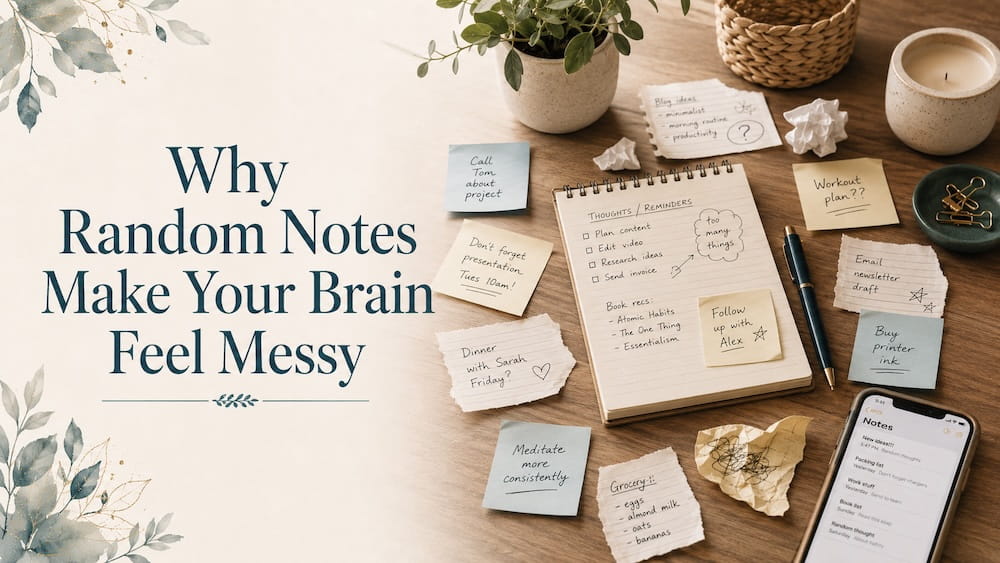
Random notes look harmless. Sitting in one corner you see:
A reminder on your phone.
A sticky note near your laptop.
A grocery item written on the back of an envelope.
A work task saved in a message.
A school reminder, bill note, appointment detail, or idea sitting somewhere you hope you will remember later.
Individually, none of these feel like a problem.
But when you are managing work, home, family needs, errands, appointments, and your own brain on top of everything else, random notes slowly become mental clutter.
Not because notes are bad.
Because scattered notes make your brain feel like it still has to supervise everything.
And that can really be exhausting.
I have done this myself, especially on busy days when writing something down felt more important than deciding where it should actually live.
The Problem Is Not Taking Notes
I actually believe writing things down is useful.
The problem starts when everything gets written down in different places.
One thing in a notebook.
One thing in WhatsApp.
One thing in email.
One thing in your phone notes app.
One thing on a sticky note.
One thing still floating in your head.
Now your brain has a new job.
It has to remember where what was written.
That itself defeats the whole purpose.
A note should reduce mental load.
But scattered notes quietly increase it.
Why Random Notes Feel So Heavy
Random notes create stress because they are unfinished loops.
They tell your brain:
“Something needs attention, but we don’t know when or where.”
That is why even small reminders and admin tasks can feel mentally noisy.
The issue is rarely the note itself.
The issue is the lack of a system around it.
A note without a place becomes another loose thread.
And working women already carry enough loose threads:
- work follow-ups
- home tasks
- bills
- groceries
- appointments
- family reminders
- things to check later
- ideas that arrive at the worst possible time
But when all of these live in different places, life starts feeling messier than it actually is.
The Hidden Cost of Scattered Notes
The biggest cost of scattered notes is not forgetfulness.
It is mental scanning. The constant mind struggle to remember where you have kept them.
You keep thinking:
- Where did I put it?
- Was it in my notebook?
- Did I save it on my phone?
- Was it in a message?
- Did I already deal with it?
- and the best one, did I even write that down?
That background scanning drains energy.
It also makes it harder to focus on the job at hand because part of your attention is always checking for something unfinished.
This is one reason mental clutter builds up so quietly. If this sounds familiar, my article on mental clutter goes deeper into why your brain feels overloaded even when nothing dramatic is happening.
What Helps: One Capture Place
The simplest fix is not a fancy app.
It is deciding where things go first.
I call this a capture place.
It can be:
- a small notebook
- one notes app
- a weekly planner page
- a simple “inbox” list
I usually prefer a simple notebook or one clean notes app for this. The tool does not need to be fancy; it just needs to be easy enough so that it can be used daily.
Once I started using one capture place first, the next step was deciding what each note was actually for. That is where my simple three-bucket notes system came from.
The tool matters less than the rule.
The rule is:
Random thoughts go into one trusted place first.
That alone reduces noise.
Because your brain no longer has to chase reminders across five different locations.
My Simple Rule for Notes
Once I stopped keeping random notes in different places, I still needed a simple way to decide what each note was for.
So I use three categories:
1. Now
Things I need to act on soon.
Example:
- call someone
- pay a bill
- reply to a message
- finish a small task
2. Later
Things that matter, but not today.
Example:
- ideas
- things to research
- products to compare
- appointments to plan
- errands for another day
3. Reference
Things I may need again.
Example:
- login reminders
- document notes
- recurring information
- instructions
- useful links
That is enough structure for me.
I do not need complicated tags or dozens of folders. I only need to know whether something belongs to Now, Later, or Reference.
If you want to see exactly how I use this three-bucket system, I explain it in How I Organise My Notes Without Fancy Apps.
Don’t Let Notes Become Another Project
This is important.
The solution is not to spend three hours reorganising every note you have ever written.
That is how simple systems become annoying systems.
Start with new notes.
From today onward, decide:
“Where will random notes go first?”
That is enough to start with.
Once the new flow becomes clear, older notes can be cleaned slowly if needed.
No dramatic life reset required.
What This Changes
When random notes have a place, your brain relaxes a little.
You don’t have to keep mentally holding every reminder.
You don’t have to search across notebooks, apps, scraps, and messages.
You don’t have to trust memory for things that should have been captured properly.
That is the real benefit.
Not productivity.
Relief.
Because a good note system is not about becoming more organized for the sake of it.
It is about making life feel easier to carry.
Final Thought
Random notes are not the problem.
Scattered notes are.
When everything lives everywhere, your brain keeps working in the background.
But when notes have a simple place to land, the noise reduces.
And sometimes, that tiny bit of order is enough to make the day feel calmer.
Related Posts
- Mental Clutter: Why Your Brain Feels Overwhelmed All the Time
- Why Your To-Do List Keeps Failing You
- How I Simplified My Daily Routine
- Tiny Systems That Quietly Reduced My Daily Stress
* This post may contain affiliate links. If you buy through them, I may earn a small commission at no extra cost to you.